Table of Contents
- Key Takeaways
- How Can Rehabilitation Support Recovery During Regenerative Medicine Care?
- What Is Regenerative Medicine?
- What Types of Regenerative Medicine Approaches Are Used or Studied?
- Which Rehabilitation Techniques May Be Used During Regenerative Medicine Care?
- How Can Rehabilitation Support Functional Recovery?
- What Should Patients Consider About Rehabilitation During Regenerative Medicine Care?
- Looking Ahead
- Frequently Asked Questions
Rehabilitation can support regenerative medicine care by addressing the patient’s mobility, strength, flexibility, balance, and daily function based on personal needs. Its role may vary depending on the medical condition, regenerative medicine approach, and overall care plan. Rehabilitation should therefore be considered as a separate component of patient care rather than as evidence that a regenerative medicine intervention will produce a particular outcome.
Key Takeaways
- Rehabilitation may support mobility, strength, flexibility, balance, and daily function during regenerative medicine care.
- The rehabilitation approach and timing depend on the patient’s medical condition, functional needs, and overall care plan.
- Different regenerative medicine approaches have different levels of clinical evidence and may be established, investigational, or under research.
- Rehabilitation has a separate role from the biological intervention and should not be presented as evidence that regenerative medicine will produce a specific outcome.
- Patients should discuss rehabilitation planning with their healthcare team and consider the evidence, safety, and suitability of the specific approach being considered.
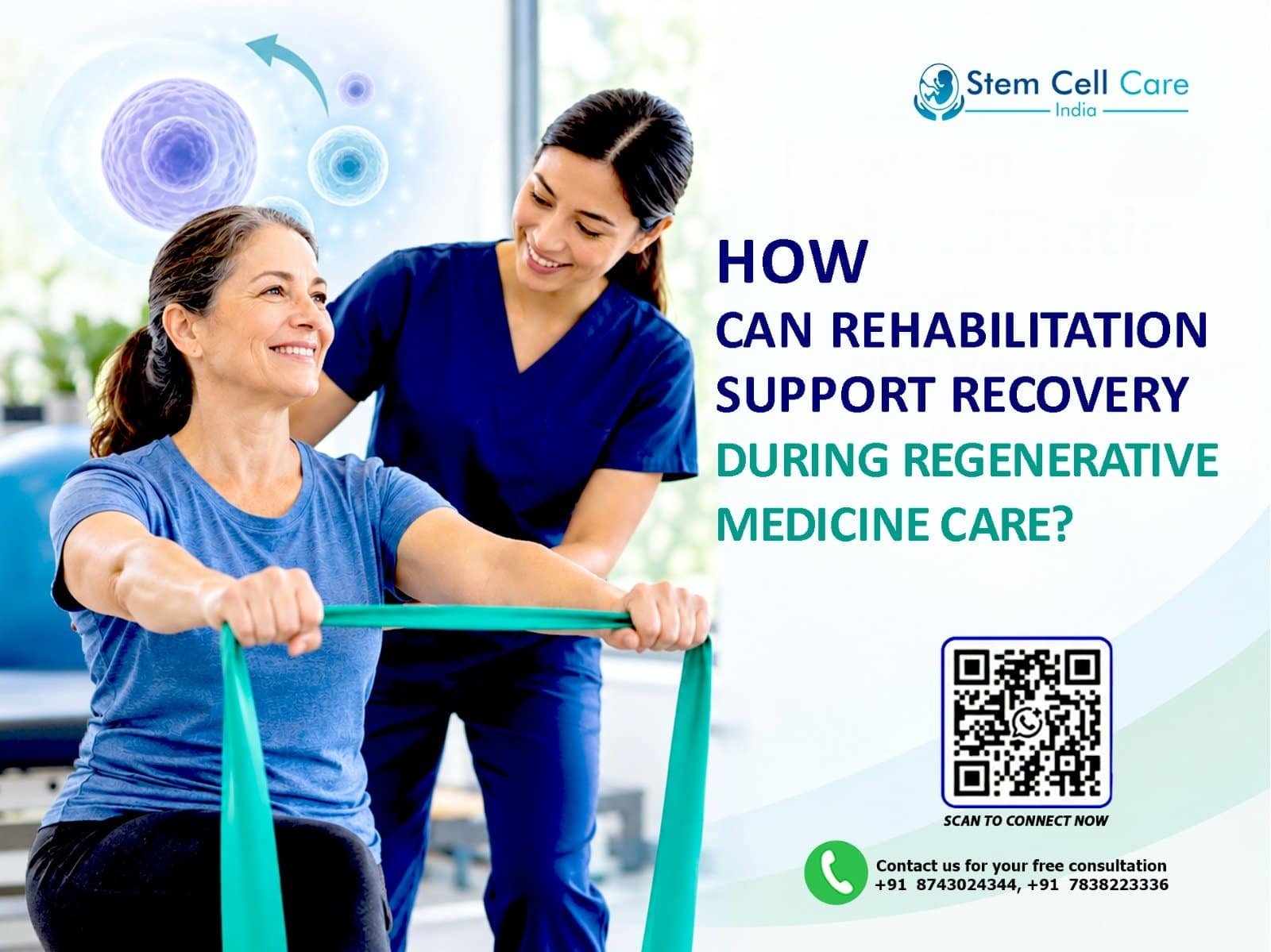
How Can Rehabilitation Support Recovery During Regenerative Medicine Care?
When seeking regenerative medicine care, patients may focus mainly on the procedure or intervention itself. However, the recovery can also involve working on physical function, mobility, strength, or everyday activities depending on the medical condition. Rehabilitation may support this broader care plan by addressing these functional needs alongside appropriate medical care.
Knowing how rehabilitation fits into regenerative medicine may help patients develop realistic expectations about recovery and the role of various medical approaches. A stem cell-based approach studied or used for one condition does not automatically apply to every patient. Patients should consider their individual medical needs, the evidence for the specific intervention, and guidance from a qualified healthcare professional before making a decision.
What Is Regenerative Medicine?
Regenerative medicine is an active area of medicine and research that explores how cells, tissues, and biological material in the human body may be used to address damage or loss of function. Stem cell-based approaches are one area of regenerative medicine research.
The clinical status of regenerative medicine approaches varies. Some regenerative medicine applications have established medical uses, while others remain investigational or under clinical research.
For patients, the specific medical condition, intervention, safety evidence, and clinical research should be the focus of consideration when understanding where an approach stands. Rehabilitation serves a separate role by focusing on functional needs such as movement, strength, mobility, and daily activities.
What Types of Regenerative Medicine Approaches Are Used or Studied?
Regenerative medicine includes several approaches that are being studied or used for different medical conditions. Their clinical status and supporting evidence vary by application.
- Stem cell therapy: Research may use various kinds of stem cells, such as hematopoietic stem cells and mesenchymal stem cells, depending on their intended application in the field of medicine.
- Tissue engineering: Tissue engineering is another area where researchers combine various biological materials with cells and scaffolds.
- Biological Approaches: Some research is also investigating biological materials and signals that may influence cellular or tissue processes.
Patients should consider the evidence for the specific approach and medical condition rather than assuming that findings from one regenerative medicine approach apply to another.
Which Rehabilitation Techniques May Be Used During Regenerative Medicine Care?
Rehabilitation approaches are usually personalised based on the patient’s medical condition, functional limitations, and recovery goals. The programme may change depending on patient needs and should follow appropriate medical guidance.
Common approaches may include:
- Therapeutic Exercises: Exercises may be used to improve strength, flexibility, and fitness based on the needs of the patient.
- Mobility Training: Exercises and movement strategies may help patients practise safe movement and maintain mobility where appropriate.
- Balance and Coordination Exercises: These may also be incorporated into the treatment if balance and coordination are affected by the disease.
- Functional Training: Rehabilitation can focus on everyday activities that are important to the patient’s recovery, such as walking, exercise, and other routine movements.
- Activity Progression: Activities can be modified gradually depending on the condition, tolerance, and functional objectives of the patient.
Not every patient will need the same rehabilitation methods. Rehabilitation should be based on the specific clinical scenario instead of assuming that rehabilitation is an integral component of all regenerative medicine therapies.
How Can Rehabilitation Support Functional Recovery?
Rehabilitation goals can include maintaining or developing physical function, practising everyday movements, and improving independence where appropriate. These goals are assessed through the rehabilitation plan and should not be used as evidence that the underlying regenerative medicine intervention has produced a biological effect.
Depending on the individual’s needs, rehabilitation may support:
- Maintaining Physical Function: Physical activity could assist in the development of existing physical functions based on the patient’s ability and condition.
- Mobility and Movement: Exercise could assist in practising the required movements for everyday actions.
- Strength and Flexibility: Rehabilitation programs could assist in solving limitations in strength or flexibility that influence physical function.
- Balance and Coordination: Exercises could be provided in case of problems with these abilities.
- Daily Activities: Functional training may revolve around activities that help the patient gain independence and enhance the quality of life.
Such objectives fall under rehabilitation as part of care and should by no means be taken as proof that the use of regenerative therapy will result in the mentioned outcome. Expected rehabilitation objectives depend on the patient, disease, therapy, and available medical information.
What Should Patients Consider About Rehabilitation During Regenerative Medicine Care?
Rehabilitation should always be planned according to the patient’s medical condition, functional needs, and overall care. However, timing and intensity may vary based on the regenerative medicine approach and the individual’s clinical circumstances.
Patients need to consider:
- Timing of rehabilitation
- What type of activities are suitable
- Adjustment of exercise intensity
- How progress will be measured
Rehabilitation may support physical function when clinically appropriate, but its use alongside a regenerative medicine intervention does not by itself establish that the intervention will produce better clinical outcomes.
Looking Ahead
If you are considering a regenerative medicine approach, discuss the available evidence, potential risks, and whether rehabilitation is appropriate for your condition with a qualified healthcare professional. Understanding the role of rehabilitation separately from the intervention can help you set realistic goals and make a more informed decision about your care.
Stem Cell Care India can help you understand your options and the available evidence for your situation. Contact our team for a medical consultation and take the next step toward an informed decision about your care.
Frequently Asked Questions
Q1. Do you need rehabilitation during regenerative medicine care?
Not every patient needs rehabilitation. Whether it is appropriate depends on the medical condition, functional needs, regenerative medicine approach, and recommendations of the healthcare team.
Q2. When should rehabilitation start after regenerative medicine care?
There is no standard timeline for everyone. The timing should be determined according to the patient’s condition, the specific intervention, and the clinical guidance provided by the treating team.
Q3. What rehabilitation exercises may be used with regenerative medicine?
Exercises may include activities focused on strength, flexibility, mobility, balance, coordination, or functional movement. The choice depends on the patient’s individual limitations and recovery goals.
Q4. Can rehabilitation be used with investigational regenerative medicine approaches?
Rehabilitation may be included in supportive care when medically appropriate. However, rehabilitation does not establish the safety or effectiveness of an investigational regenerative medicine approach.
Q5. Does rehabilitation improve the effectiveness of regenerative medicine?
There is no single answer for all regenerative medicine approaches. Evidence needs to be assessed for the specific condition, intervention, and rehabilitation programme. Some studies are investigating whether rehabilitation influences patient outcomes, but findings from one condition should not automatically be applied to another.
Q6. How is rehabilitation planned for patients receiving regenerative medicine care?
A rehabilitation plan is based on factors such as the patient’s medical condition, physical abilities, functional goals, and overall care plan. Healthcare professionals can determine which techniques and activity levels are appropriate.
Reference Links
Cottmeyer DF, Chiu M, Maltusch K, Tsai LC. Towards optimised rehabilitation with regenerative therapy: A systematic review and meta-analysis on the effects of cell-based injections for knee osteoarthritis. 2026.
https://pubmed.ncbi.nlm.nih.gov/41733018/
Deng C, Aldali F, Luo H, Chen H. Regenerative rehabilitation: a novel multidisciplinary field to maximise patient outcomes. 2024.
https://pubmed.ncbi.nlm.nih.gov/39444794/
Tashiro S, et al. Current progress of rehabilitative strategies in stem cell therapy for spinal cord injury: a review. 2021.
https://pubmed.ncbi.nlm.nih.gov/34824291/
Rehabilitation following regenerative medicine treatment for knee osteoarthritis: current concept review. 2019.
https://pubmed.ncbi.nlm.nih.gov/30705534/
Moritz CT, Ambrosio F. Regenerative Rehabilitation: Combining Stem Cell Therapies and Activity-Dependent Stimulation. 2017.
https://pubmed.ncbi.nlm.nih.gov/28654473/
International Society for Stem Cell Research. 2025 Guidelines for Stem Cell Research and Clinical Translation.
https://www.isscr.org/guidelines/clinical-translation-of-stem-cell-based-interventions
Medical Disclaimer
This blog is for general educational purposes and does not replace personalised medical advice, diagnosis, or treatment. The suitability, safety, and clinical evidence for regenerative medicine approaches vary by condition and individual circumstances. Patients should consult a qualified healthcare professional before making decisions about their care.