Table of Contents
- What Are Stem Cells?
- Where Do Adult Stem Cells Come From and What Are They Used for?
- What Are the Common Sources of Adult Stem Cells?
- How Are Adult Stem Cells Studied?
- Where Do Embryonic Stem Cells Come From and Why Are They Studied?
- What Are the Key Differences Between Adult and Embryonic Stem Cells?
- What Are the Ethical and Legal Aspects of Stem Cell Research in India?
- Looking Ahead
- Frequently Asked Questions
- Medical Disclaimer
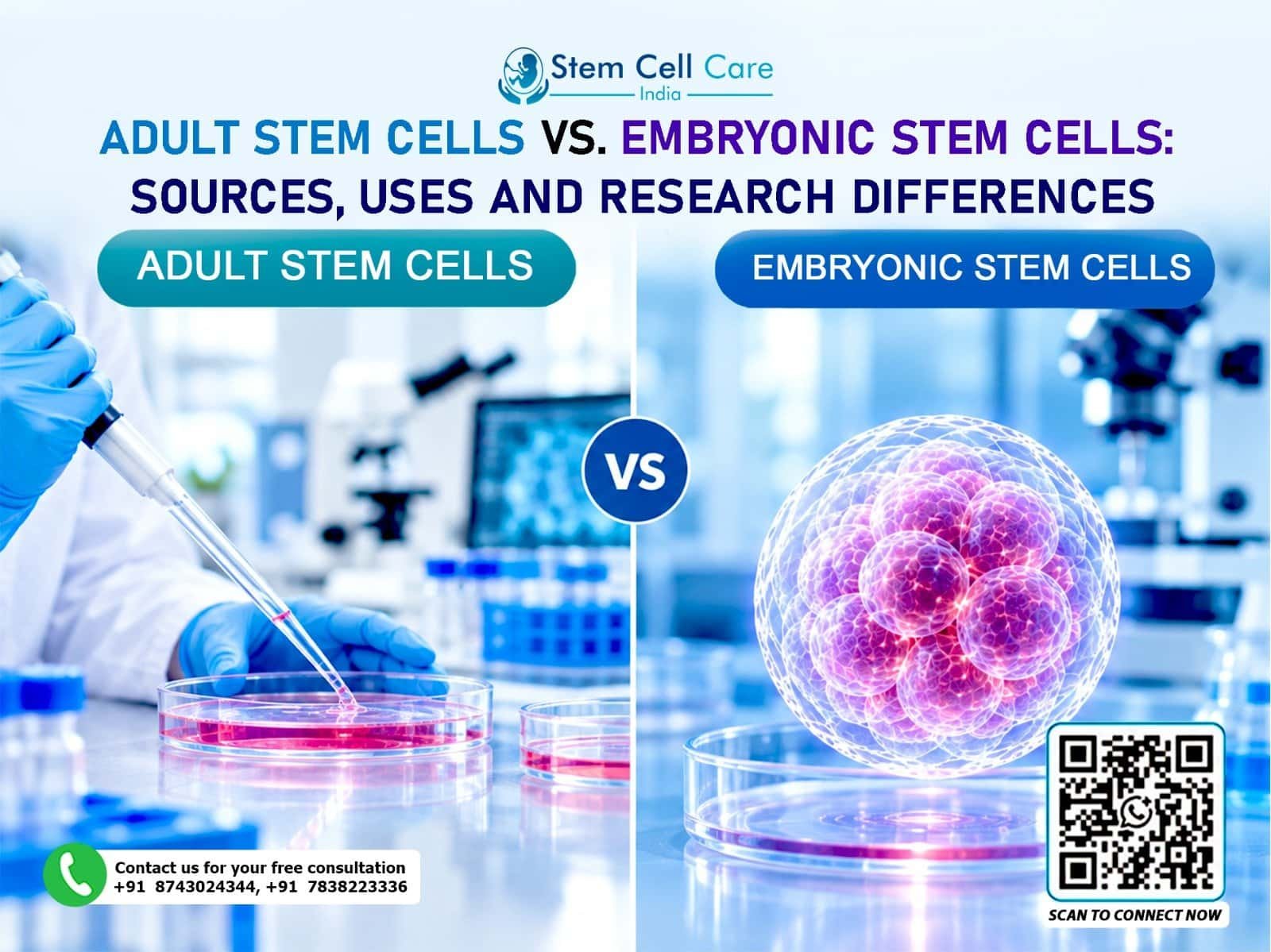
Adult and embryonic stem cells are both types of stem cells that can produce specialised cells, although they differ in nature, source and developmental potential. Adult stem cells are usually sourced from tissues or organs after development, while embryonic stem cells come from the inner cell mass of an early-stage embryo. These differences affect how the cells are studied, what researchers can use them for, and the ethical considerations surrounding their use.
Key Takeaways
- Adult stem cells are found in developed tissues and include different populations with specialised biological roles, such as blood formation and tissue maintenance.
- Embryonic stem cells are derived from early-stage embryos and can develop into many specialised cell types, making them important in laboratory research.
- Adult and embryonic stem cells differ in their sources, developmental potential, research applications, and ethical considerations.
- Embryonic stem-cell research involves additional ethical and regulatory considerations because obtaining these cells involves human embryos.
- In India, stem cell research is governed by ICMR–DBT guidelines, which define permitted, restricted, and prohibited areas of research.
Adult Stem Cells vs. Embryonic Stem Cells: Sources, Uses and Research Differences
When you hear the term “stem cell,” it can sound as though all stem cells work in the same way. They do not. Adult and embryonic stem cells differ in where they come from, what they can develop into, how researchers study them, and the ethical considerations surrounding their use.
Adult stem cells are usually sourced from developed tissues, while embryonic stem cells, on the other hand, come from early-stage embryos. In this blog, we’ll look at how both stem cell types function, how they are studied, and the ethical and legal considerations surrounding their use.
What Are Stem Cells?
Stem cells are cells that can self-renew and, depending on their type, differentiate into other cell types. These characteristics allow researchers to study how tissue develops, how cells change, and how different stem cell populations may be utilised in medical research.
Stem cells are usually classified depending on their source and developmental potential, such as:
- Adult Stem Cells: Present in tissues that have already matured and tend to have less differentiation capacity.
- Embryonic Stem Cells: Derived from the inner cell mass of early-stage embryos and are able to differentiate into many kinds of cells.
This difference matters when it comes to comparisons between adult and embryonic stem cells. Below are further discussions about where each kind originates, how it is studied, and its ethical and regulatory concerns.
Where Do Adult Stem Cells Come From and What Are They Used for?
Adult stem cells are commonly found in various tissues after development and support the maintenance and replacement of cells within those tissues. Their characteristics may differ based on their origin, which affects how they are studied in research.
What Are the Common Sources of Adult Stem Cells?
- Bone Marrow: Bone marrow contains hematopoietic stem cells, which give rise to blood cells and form the basis of established hematopoietic stem-cell transplantation for selected conditions.
- Peripheral Blood: Hematopoietic stem cells can be collected from peripheral blood after mobilisation, a process used to increase the number of these cells circulating in the bloodstream.
- Adipose Tissue: Adipose tissue contains stromal and other cell populations that researchers study for their biological properties and potential applications.
How Are Adult Stem Cells Studied?
Adult stem cells are investigated for their potential roles in tissue regeneration, cell replacement and disease research. Some adult stem-cell populations have established clinical applications, while many other proposed uses remain under investigation.
The cell type, source, preparation method, and medical indication are important when evaluating the evidence for any particular application.
Where Do Embryonic Stem Cells Come From and Why Are They Studied?
Embryonic stem cells are sourced from the inner cell mass of a blastocyst, an early stage of embryo development. They are pluripotent in nature, which means they can develop into many types of specialised cells. This potential makes them an important part of clinical research on cell development, disease processes, and cell-based approaches.
Scientists investigate embryonic stem cells in fields like:
- Cell Development: Determining how undifferentiated cells become differentiated cells.
- Disease Investigation: Studying diseases and changes in cells in the laboratory.
- Drug Research: Investigating the effect of potential drugs on cells.
- Cell-based Research: Researchers study whether specialised cells derived from embryonic stem cells could support future medical applications.
However, the use of research cannot be confused with the use of established treatment. Embryonic stem cell research poses ethical issues due to the fact that getting such cells requires using human embryos at an early stage.
The ICMR–DBT National Guidelines for Stem Cell Research place specific restrictions on research involving human embryos in India.
What Are the Key Differences Between Adult and Embryonic Stem Cells?
Although both types of stem cells can turn into specialised cells, they often differ in several important ways. Knowing these differences helps patients understand why they are studied differently and why the ethical and regulatory considerations are not the same.
| Features | Adult Stem Cells | Embryonic Stem Cells |
| Source | Found in developed tissues such as bone marrow and peripheral blood | Derived from the inner cell mass of an early-stage embryo |
| Development Potential | Generally more restricted and often associated with particular cell lineages, depending on the stem-cell population. | Pluripotent, with the potential to form many specialised cell types |
| Main Research Focus | Tissue maintenance, cell replacement, disease research, and established transplantation applications | Cell development, disease modelling, drug research, and potential cell-based applications |
| Ethical Considerations | Generally fewer ethical concerns related to their source | Raises additional ethical questions because their derivation involves human embryos |
| Clinical Status | Some applications, such as hematopoietic stem-cell transplantation, are established for specific conditions | Clinical status depends on the specific cell type, application, condition, evidence, and regulatory framework. |
Source alone does not determine whether a stem-cell application is clinically established. The specific cell type, preparation, intended use, medical condition, supporting evidence, and applicable regulatory requirements all matter.
What Are the Ethical and Legal Aspects of Stem Cell Research in India?
Embryonic stem cell research has been under strict ethical and regulatory consideration as it involves cells derived from early-stage human embryos. In India, stem cell research is governed by the ICMR-DBT National Guidelines for Stem Cell Research, which classifies certain research activities as permissible, restricted, or prohibited.
Some of the considerations include:
- Research on Embryos: Some research activities involving human embryos may be limited by the guidelines.
- Research Duration: The in vitro culture of intact human embryos beyond 14 days after fertilisation or development of the primitive streak, whichever comes first, is not allowed.
- Reproductive Cloning: The guidelines prohibit reproductive cloning and place restrictions on certain related research activities.
- Implantation of Embryos: The implantation of human embryos after in vitro manipulation in human beings or primates is forbidden.
For the patient, it is essential to make a distinction between stem-cell research and clinical practice. Research on a certain type of stem cells does not automatically make it a treatment method available in India for clinical purposes.
What Should Patients Understand About Stem Cell Research?
Seeing new stem cell-based approaches under research does not mean that the particular approach is an established medical practice for every medical condition. Patients should check the specific cell type, evidence, intended use, and regulatory status before seeking any stem cell-based medical approach.
This differentiation is particularly important when comparing the uses of adult stem cells to embryonic stem cells because their applications vary.
Looking Ahead
Understanding how adult and embryonic stem cells differ can help patients interpret stem cell research more carefully. If you are considering a stem-cell-based approach, discuss the specific cell type, available evidence, intended use, and regulatory status with a qualified healthcare professional.
If you are exploring stem-cell care in India, contact Stem Cell Care India for a consultation to understand whether further medical evaluation may be appropriate for your situation.
Frequently Asked Questions
Q1. Can adult stem cells be collected from a living person?
Yes. Depending on the cell population, adult stem cells can be collected from sources such as bone marrow or peripheral blood. Whether those cells can be used clinically depends on the specific application, evidence, and applicable medical and regulatory requirements.
Q2. Are adult stem cells found in all parts of the body?
No. Adult stem cells are associated with particular tissues and organs rather than being uniformly present throughout the body. Different tissues contain different stem-cell populations with distinct biological characteristics.
Q3. How are embryonic stem cells obtained for research?
Embryonic stem cells are obtained from the inner cell mass of a blastocyst. Their derivation involves early-stage human embryos, which is why this area of research involves additional ethical considerations.
Q4. Why do researchers use stem cells in laboratory studies?
Stem cells provide models for studying cell development and biological processes. Researchers can also use stem-cell-derived cells to investigate diseases and evaluate potential medicines in laboratory settings.
Q5. Are stem cells the same as specialised body cells?
No. Stem cells have the ability to self-renew and, depending on their type, differentiate into other cell types. Specialised cells such as nerve, muscle, or blood cells perform more specific functions.
Q6. Does the source of a stem cell affect its research use?
Yes. The source influences the characteristics and developmental potential of the cells, which can affect how researchers use them in laboratory studies and how their potential applications are evaluated.
Reference Links
Bhartiya D. (2021). Adult tissue-resident stem cells—fact or fiction? Stem Cell Research & Therapy, 12, 73.
https://doi.org/10.1186/s13287-021-02142-x
International Society for Stem Cell Research. (2024). The ISSCR Guide to Stem Cell Treatments. https://www.isscr.org/s/ISSCR_PatientHandbook_v12_Feb2024_Redesign_v4b.pdf
Indian Council of Medical Research & Department of Biotechnology. (2017). National Guidelines for Stem Cell Research. https://www.icmr.gov.in/icmrobject/custom_data/pdf/resource-guidelines/Guidelines_for_stem_cell_research_2017.pdf
Indian Council of Medical Research. (2021). Evidence-Based Status of Stem Cell Therapy for Human Diseases. https://www.icmr.gov.in/icmrobject/uploads/Guidelines/1745229591_evidence_based_status_of_stem_cell_therapy_for_human_diseases_v1.pdf
International Society for Stem Cell Research. (2025). ISSCR Guidelines for Stem Cell Research and Clinical Translation. https://www.isscr.org/guidelines/clinical-translation-of-stem-cell-based-interventions
Medical Disclaimer
This blog is for general educational purposes only and does not replace personalised medical advice, diagnosis, or treatment. The characteristics, clinical uses, safety, and research status of different stem cell types vary by application and individual circumstances. Always consult a qualified healthcare professional before making decisions about your care.