Table of Contents
- Key Takeaways
- What Factors Do Doctors Consider When Assessing a Patient for Regenerative Medicine?
- What Does a Patient’s Medical History Tell Doctors About Regenerative Medicine Suitability?
- How Does the Specific Health Condition Affect Regenerative Medicine Options?
- Does Age Affect Regenerative Medicine Suitability and Expected Outcomes?
- How Do Lifestyle Factors Affect Regenerative Medicine Care?
- How Do Doctors Assess Risks and Safety Before Regenerative Medicine Care?
- What Happens After a Doctor Assesses These Factors?
- The Bottom Line
- Frequently Asked Questions
- Reference Links
- Medical Disclaimer
Doctors assess whether a regenerative medicine approach may be appropriate by reviewing the patient’s medical history, condition, overall health, and potential risks. They also consider the evidence available for the specific approach and whether further evaluation, another care option, or a clinical research pathway may be more appropriate.
Key Takeaways
- Doctors review a patient’s medical history before considering a regenerative medicine approach.
- The specific health condition helps determine whether relevant clinical evidence exists for the proposed approach.
- Age is considered alongside overall health and other individual clinical factors rather than used as a standalone criterion.
- Lifestyle factors can provide additional context about general health and factors that may need attention.
- Safety assessment helps doctors weigh potential risks against the available evidence and the patient’s circumstances.
What Factors Do Doctors Consider When Assessing a Patient for Regenerative Medicine?
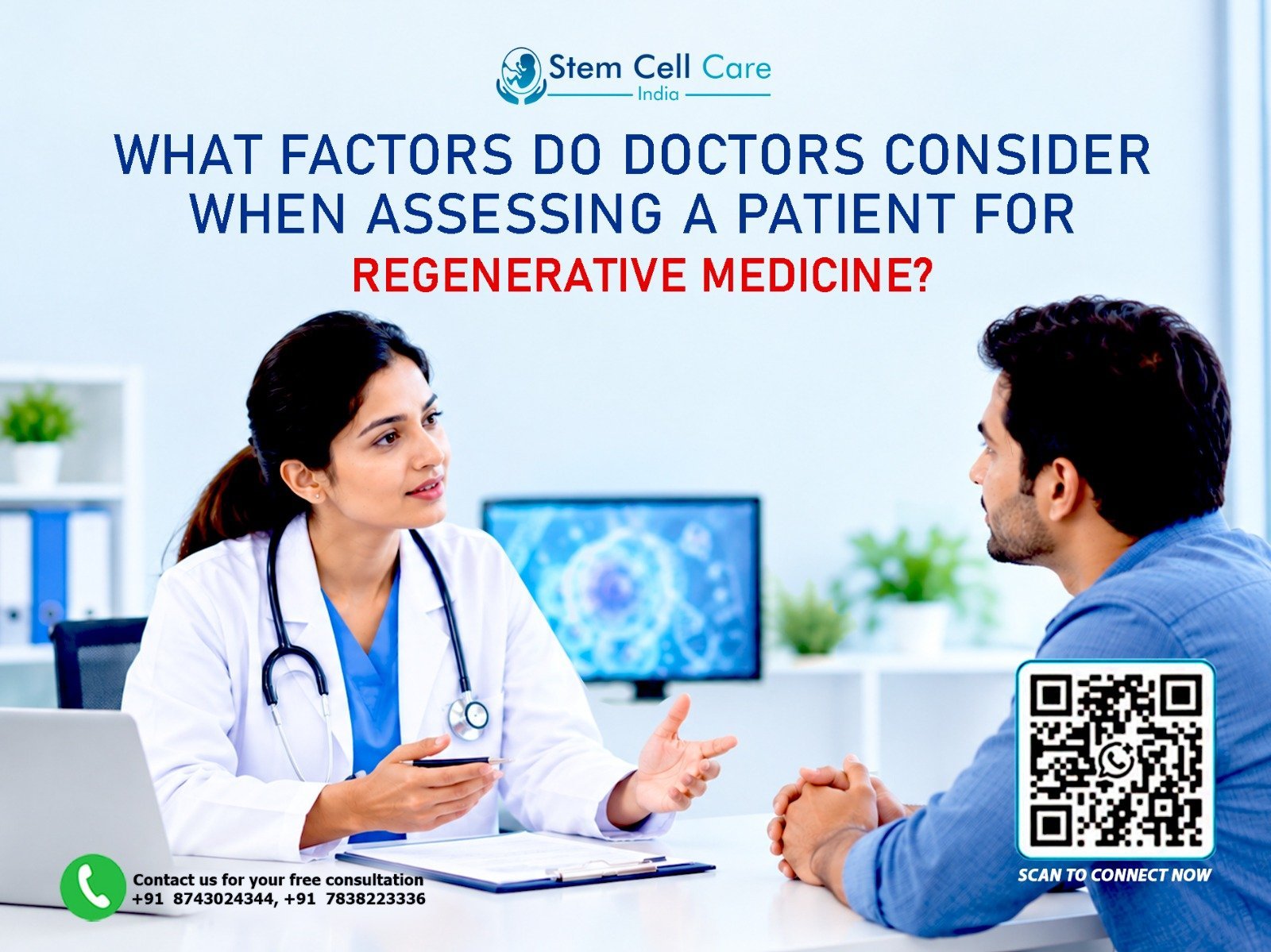
When patients are considering an emerging medical approach, it is natural to want to know whether it is appropriate for their particular situation. Regenerative medicine is not a single type of care, and the evidence can differ depending on the condition and approach being considered. Doctors therefore look beyond the diagnosis itself. They consider the patient’s medical history, current health, specific condition, available evidence, and potential safety concerns before discussing whether a particular approach should be considered.
However, the evaluation process also varies according to the particular regenerative medicine technique to be used and the evidence surrounding its clinical application. Some techniques may have medical indications, while others are still under investigation or study in clinical trials. This understanding is important to have an informed conversation between the patient and health care providers on the subject.
What Does a Patient’s Medical History Tell Doctors About Regenerative Medicine Suitability?
Before discussing a regenerative medicine approach, doctors review the patient’s medical history to understand their current health and previous medical care.
This may include:
- Previous Diagnosis: Diseases that may influence the suggested treatment plan or may require further investigation.
- Current and Past Treatments: Drugs, procedures, surgeries, or any other treatment you had before.
- Allergies and Adverse Effects: All previous allergies or adverse reactions which may be relevant to your safe treatment.
- Previous Regenerative Medicine Treatments: Any previous experience with this or similar treatment.
- Medical Records: Any reports, imaging studies, laboratory findings, and other documents that may assist in understanding your particular case.
The information will allow doctors to get a better understanding of your particular case. It may reveal whether any more documents, tests, or expert consultation are required prior to considering your case for regenerative medicine.
How Does the Specific Health Condition Affect Regenerative Medicine Options?
A diagnosis alone does not determine whether a regenerative medicine approach should be considered for the patient. Doctors look at the nature of the patient’s condition and whether the proposed approach has the level of evidence available for the particular condition.
They may consider:
- Diagnosis and Disease Stage: The specific condition and its stage or progression.
- Severity and Region Affected: How the disease manifests itself in the specific tissues, organs, or body systems involved.
- Current Medical Management: The existing treatment the patient undergoes for the disease.
- Research Evidence: Whether the proposed strategy has been studied for the particular disease or not and what research shows.
This classification is important because evidence from one condition or regenerative medicine approach should not automatically be applied to a different condition or approach. In the case of a lack of evidence, the physician must discuss it with the patient beforehand.
Does Age Affect Regenerative Medicine Suitability and Expected Outcomes?
Age may be relevant to a medical assessment, but it is usually considered alongside overall health, medical conditions, functional status, and the specific approach being evaluated. Doctors may consider a patient’s age alongside the patient’s overall health, functional status, medical conditions, and the specific approach being evaluated.
A doctor may also consider:
- Overall Health: The patient’s general health status and any condition that could affect the medical approach.
- Functional Status: The doctor also determines if the patient’s current mobility, independence, and ability to manage daily activities are relevant.
- Age-Related Medical Issues: Diseases or medicines that may become important as age advances.
- Evidence for the Specific Approach: Whether the study involves patients of a comparable age and medical condition.
Therefore, being older does not automatically make a patient suitable or unsuitable for the treatment. Age is one part of the broader individual assessment.
How Do Lifestyle Factors Affect Regenerative Medicine Care?
Lifestyle factors are another aspect of patient assessment, where doctors determine how a patient’s daily habits and general health routine may affect medical care, which may also help them identify factors that need attention as part of the overall care plan.
Doctors may ask about:
- Physical Activity: Determining current activity levels and any limitations affecting daily life.
- Nutrition: Everyday dietary habits and nutritional concerns that may require assessment and improvement.
- Smoking and Drinking: Behaviours that may be significant to the general health or procedure plan.
- Sleep Patterns and Day-to-Day Life: Sleep quality, stress, and other variables which provide information about general well-being.
These factors do not determine whether a regenerative medicine approach will produce a particular outcome. They provide doctors with additional information about the patient’s overall health and care needs.
How Do Doctors Assess Risks and Safety Before Regenerative Medicine Care?
Determining safety through assessment helps doctors understand whether the potential risks of a specific regenerative medicine application are suitable for the patient’s individual condition. The risks may vary considerably depending on the cells or biological material involved, how they are prepared and administered, and the medical settings.
Doctors may consider:
- Known Risks of the Approach
Understand what clinical studies and available safety evidence show about the proposed procedure.
- Procedure-Related Factors
Ask the doctor how the approach is administered and what risks may arise from the proposed procedure.
- Patient-Specific Concerns
Whether particular health circumstances could increase the potential for complications.
- Monitoring Requirements
The type and duration of monitoring that may be required after the procedure.
- Available Evidence and Uncertainty
The level of knowledge about the method and areas of safety concern that still need to be clarified.
A careful analysis doesn’t imply that all the risks can be predicted. It allows healthcare professionals to present patients with information on the known risks, limitations, and uncertainties.
What Happens After a Doctor Assesses These Factors?
A medical assessment does not always lead to a recommendation for regenerative medicine. Depending on the findings, the doctor may:
Request Further Evaluation: Sometimes additional tests, imaging, specialists’ opinions, or medical records may be required for better evaluation.
Discuss Suitability: If the proposed approach is appropriate, the doctor may explain the available evidence, potential risks, and limitations.
Explore Other Care Options: Another established or clinically appropriate care option may be more suitable for the patient.
Discuss Clinical Trials: If the approach is being studied in a clinical trial, eligibility may depend on the study’s specific criteria.
The next step should be based on the patient’s individual circumstances and the evidence available for the specific approach being considered.
The Bottom Line
Before considering regenerative medicine, discuss your condition, medical history, and the specific approach being proposed with a qualified healthcare professional. Ask about the available evidence, potential risks, uncertainties, and other care options so you can make a decision based on your individual circumstances.
Frequently Asked Questions
Q1. What tests might a doctor order before regenerative medicine care?
The tests depend on the patient’s condition and the specific approach being considered. A doctor may request blood tests, imaging, or other evaluations when they are clinically relevant.
Q2. Can a patient be unsuitable for a regenerative medicine approach?
Yes. A doctor may advise against a particular approach if there is insufficient evidence for the patient’s condition or if individual medical factors raise safety concerns.
Q3. Do existing medications affect regenerative medicine eligibility?
They can be relevant to the assessment. Doctors review current medicines to understand potential interactions, procedural considerations, and other patient-specific safety factors.
Q4. What is the difference between assessment and eligibility?
Assessment reviews your health and medical circumstances. Eligibility depends on the specific regenerative medicine approach and its medical or research criteria.
Q5. Does having multiple health conditions affect suitability?
Yes. Multiple conditions may require doctors to consider the overall clinical picture, potential risks, and whether the proposed approach is appropriate for the individual.
Q6. Can doctors recommend against regenerative medicine after an assessment?
Yes. If the available evidence is limited, risks are concerning, or another care option is more appropriate, a doctor may advise against the proposed approach.
Q7. Why does eligibility differ between regenerative medicine studies?
Clinical studies can have different eligibility criteria based on the condition being studied, patient characteristics, study design, and safety requirements. Meeting the criteria for one study does not mean a patient will qualify for another.
Reference Links
Lovell-Badge R, Anthony E, Barker RA, Bubela T, Brivanlou AH, Carpenter M, et al. (2021). ISSCR Guidelines for Stem Cell Research and Clinical Translation: The 2021 Update. Stem Cell Reports, 16(6), 1398–1408. https://doi.org/10.1016/j.stemcr.2021.05.012
Cao J, Hao J, Wang L, Tan Y, Tian Y, Ma A, et al. (2021). Developing standards to support the clinical translation of stem cells. Stem Cells Translational Medicine, 10(Suppl 2), S85–S95. https://doi.org/10.1002/sct3.13035
Frati P, Scopetti M, Santurro A, Gatto V, Fineschi V. (2017). Stem Cell Research and Clinical Translation: A Roadmap about Good Clinical Practice and Patient Care. Stem Cells International, 2017, 5080259. https://doi.org/10.1155/2017/5080259
Indian Council of Medical Research. (2021). Evidence Based Status of Stem Cell Therapy for Human Diseases. https://www.icmr.gov.in/icmrobject/uploads/Guidelines/1745229591_evidence_based_status_of_stem_cell_therapy_for_human_diseases_v1.pdf
International Society for Stem Cell Research. (2025). ISSCR Guidelines for Stem Cell Research and Clinical Translation. https://www.isscr.org/guidelines/clinical-translation-of-stem-cell-based-interventions
Medical Disclaimer
This blog is for general educational purposes only and does not replace advice from a qualified healthcare professional. The evidence, risks, and regulatory status of regenerative medicine approaches can vary by condition, intervention, and clinical setting. Always discuss your individual circumstances with an appropriately qualified medical professional before making healthcare decisions.