Table of Contents
- The Mechanism of Stem Cells in Global Developmental Delay
- Research on Stem Cell Therapy for Developmental Disorders
- Pros and Cons of Stem Cell Therapy for Global Developmental Delay
- Understanding Case-Based Reports
- Future of Stem Cell Therapy in Pediatric Neurology
- Consult With Experts: Stem Cell Care India
- Putting It All Together
- Frequently Asked Questions
- Reference Links
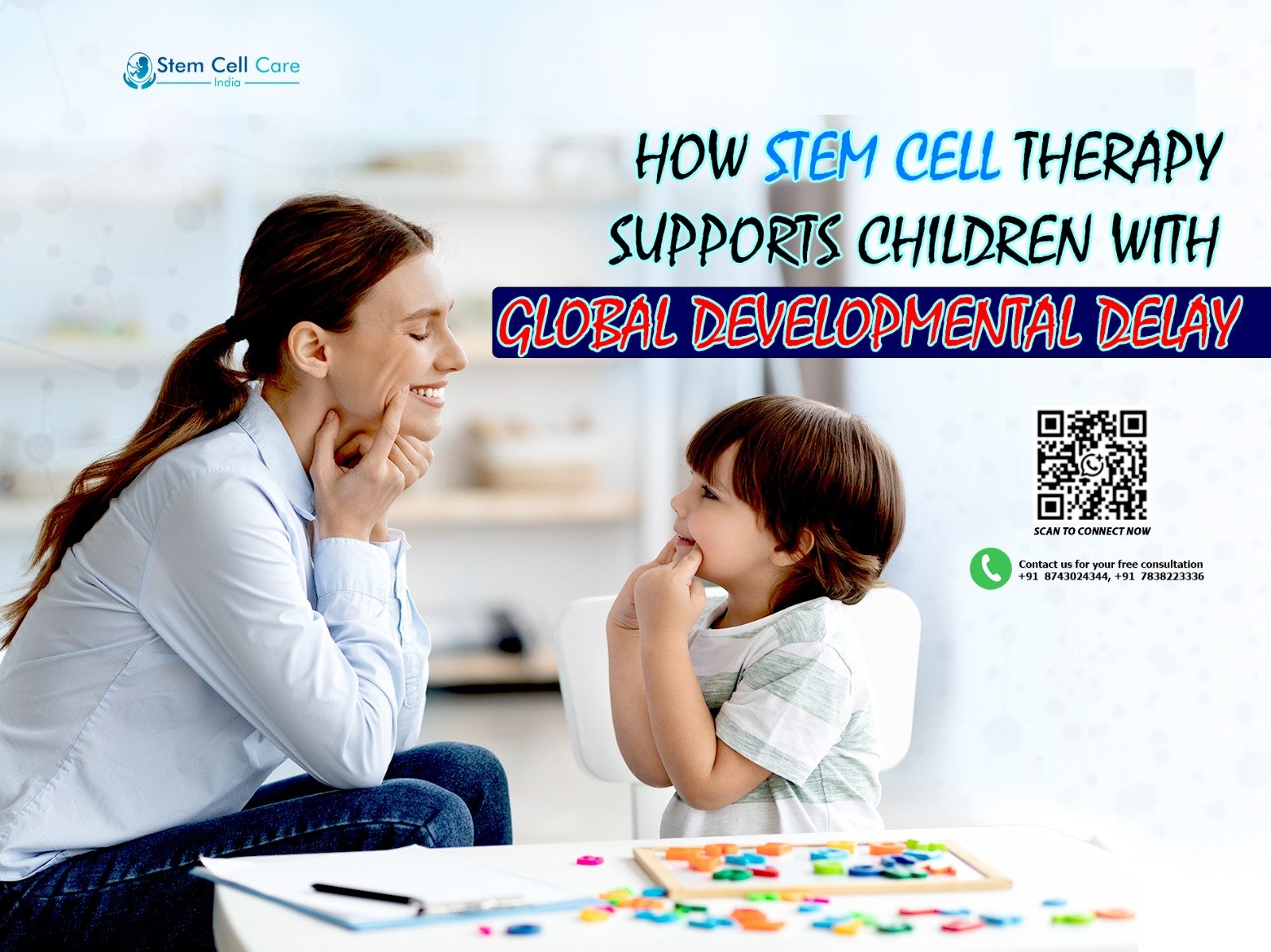
Summary: Discover how stem cell research is being explored for children with global developmental delay, what current studies suggest, and why it remains investigational rather than part of routine care.
Every parent records the milestone. First word, first step, the moment a child starts responding to their name. In some cases, when those milestones don’t arrive on time—the concern in the parents heart starts to follow is unlike anything else. For many families, looking for global development delay diagnosis, that comes with a list of many questions yet few answers. Standard treatment follows therapies that support development over time.
While stem cell therapy has sparked interest in families—but it’s not the cure but a supportive treatment and it’s important to be clear from the start. However, for some children it’s been incorporated into their overall treatment protocol.
The Mechanism of Stem Cells in Global Developmental Delay
When people hear about stem cells in regard to GDD, the first thing that comes to mind is—how can that help?
As global developmental delay usually includes problems with the processing and developing abilities of the brain, scientists are considering stem cells for their potential effects on the neural activities of the brain, and its response.
These aspects are being researched:
- If there is a chance for the stem cells to promote intercommunication of neurons
- The potential of the stem cells in lowering the inflammatory process
- Stem cell’s influence on the neurological function in general
It needs to be noted that these are the directions of research for now, and the reaction cannot be predicted or expected.
Research on Stem Cell Therapy for Developmental Disorders
Although this field of study is still evolving, it appears to be heading towards an area that cannot be ignored. Studies have been conducted on children with neurodevelopmental disorders, and they have shown improvement in motor skills, speech development, and social interaction after stem cell therapy.
There is also research that focuses on the following aspects:
- Behavioral and communicational changes
- Motor skill improvements
- Developmental progress
Although there have been some promising initial findings, the results are inconsistent. Stem cell therapy for global developmental delay is not approved as a standard treatment in India and is only available within regulated clinical research settings.
Pros and Cons of Stem Cell Therapy for Global Developmental Delay
Seeing only unrealistic benefits on the internet is one of the biggest reasons—where parents get false hope and unanswered questions. Understanding both sides is important before any family considering this option.
Positive observations that have been made:
- Improved ability to focus, communicate, and coordinate physically in children whose previous reactions to traditional therapy were less effective.
- A progressive improvement in which developments occur slowly over time, not all at once—those that show positive responses often develop gradually.
- Low risk if administered by an experienced team, although dependent on the mode of administration.
On the other side, there are some important limitations to consider:
- Results are not consistent
- Long term results are still being explored
- Responses can differ widely between children
It’s not a straightforward decision, and it’s important to look at both sides before forming expectations.
Understanding Case-Based Reports
Numerous parents have seen stories on the Internet that depict how their kids benefited from stem cell therapy. Even though they might be inspiring, they cannot be predicted as outcomes of stem cell treatment.
When it comes to medical science, clinical trials, which are broader and more controlled than personal stories, are much more valid.
Future of Stem Cell Therapy in Pediatric Neurology
It goes without saying that there is much research done in regenerative medicine, including in pediatric neurology. It is important to learn:
- How children may respond differently
- How stem cells interact with the developing brain
- What long-term outcomes look like
Progress is ongoing, but gradual. More structured and large-scale studies are still needed before this can move beyond the research stage.
Consult With Experts: Stem Cell Care India
Most of the parents who visit Stem Cell Care India have common worries—after researching various choices, it is still unclear how they apply to their children’s cases.
Our role is to bring that clarity by assisting patients with:
- We evaluate your child’s condition comprehensively.
- We translate the latest scientific knowledge into actionable information for you.
- We discuss the possibilities of enrolling in clinical trials.
- We facilitate international consultations, if allowed.
- We advise you on issues related to rehabilitation and therapy.
Ultimately, our goal is not to persuade parents but to help them make informed decisions.
Putting It All Together
A global developmental delay will need patience, consistency, and effective support. Despite advances in stem cell therapy and regenerative medicine, this area is still under development and cannot be considered standard treatment.
If you are thinking about trying something new, you will have to make sure that you concentrate on tested methods but still stay informed on developments in medical science. If you choose to pursue this route, contact Stem Cell Care India for assistance.
Frequently Asked Questions
Q1. At what age can a child receive stem cell therapy for global developmental delay?
Children at a younger age are likely to benefit more from this procedure as the brain cells are highly responsive at this stage. However, the child’s condition would decide their eligibility.
Q2. How many sessions of stem cell therapy will a child with developmental delays need?
The number of sessions is based on the child’s response. While some children might be observed after only one session—others need multiple sessions.
Q3. Will stem cell therapy affect my child’s current developmental therapy?
No. In fact, stem cell therapy goes hand-in-hand with speech therapy, occupational therapy, and any other treatments your child may already be undergoing.
Q4. What are the indications that stem cell treatment is effective on our child?
Improvements usually occur progressively, possibly even noticeable in treatment sessions prior to being detected at home. Developmental milestones are measured in the long term.
Q5. Are stem cells safe for children with GDD?
As long as the procedure is conducted by a competent clinical team after conducting necessary evaluations, the risks are often deemed acceptable. There is no such thing as a completely risk-free medical process, hence, a consultation with your specialist is crucial.
Reference Links
National Institute of Neurological Disorders and Stroke (NINDS) — Developmental Disorders Overview
https://www.ninds.nih.gov/health-information/disorders
PubMed Central — Stem Cell Therapy in Neurological Disorders
https://www.ncbi.nlm.nih.gov/pmc/articles/PMC7230377/
Frontiers in Neurology — Stem Cell Research in Developmental Disorders
https://www.frontiersin.org/articles/10.3389/fneur.2020.00930/full
Nature Reviews Neurology — Advances in Pediatric Neurology Research
https://www.nature.com/articles/s41582-018-0097-3
International Society for Stem Cell Research (ISSCR) — Clinical Guidelines
https://www.isscr.org/policy/guidelines-for-stem-cell-research-and-clinical-translation