Table of Contents
Summary: Crohn’s disease can be hard to manage over time. As the standard treatment focus on only symptoms—regenertive medicine, on the other hand, being explored for better treatment options.
Crohn’s disease does not follow a straight path. For many people, it comes with many different phases. These phases come with sudden flare-ups that affect your digestion, energy levels, and daily comfort. Over time, managing the condition becomes less about treatment more about adjusting ongoing symptoms.
Although traditional treatment helps patients, it does not bring consistent relief for everyone. This makes patients look for more suitable treatment areas like regenerative medicine. As stem cell research is being discussed more often nowadays as a more suitable alternative treatment for many conditions—understanding what it actually means and what is still uncertain is important before undertaking any regenerative treatment.
What is Stem Cell Therapy?
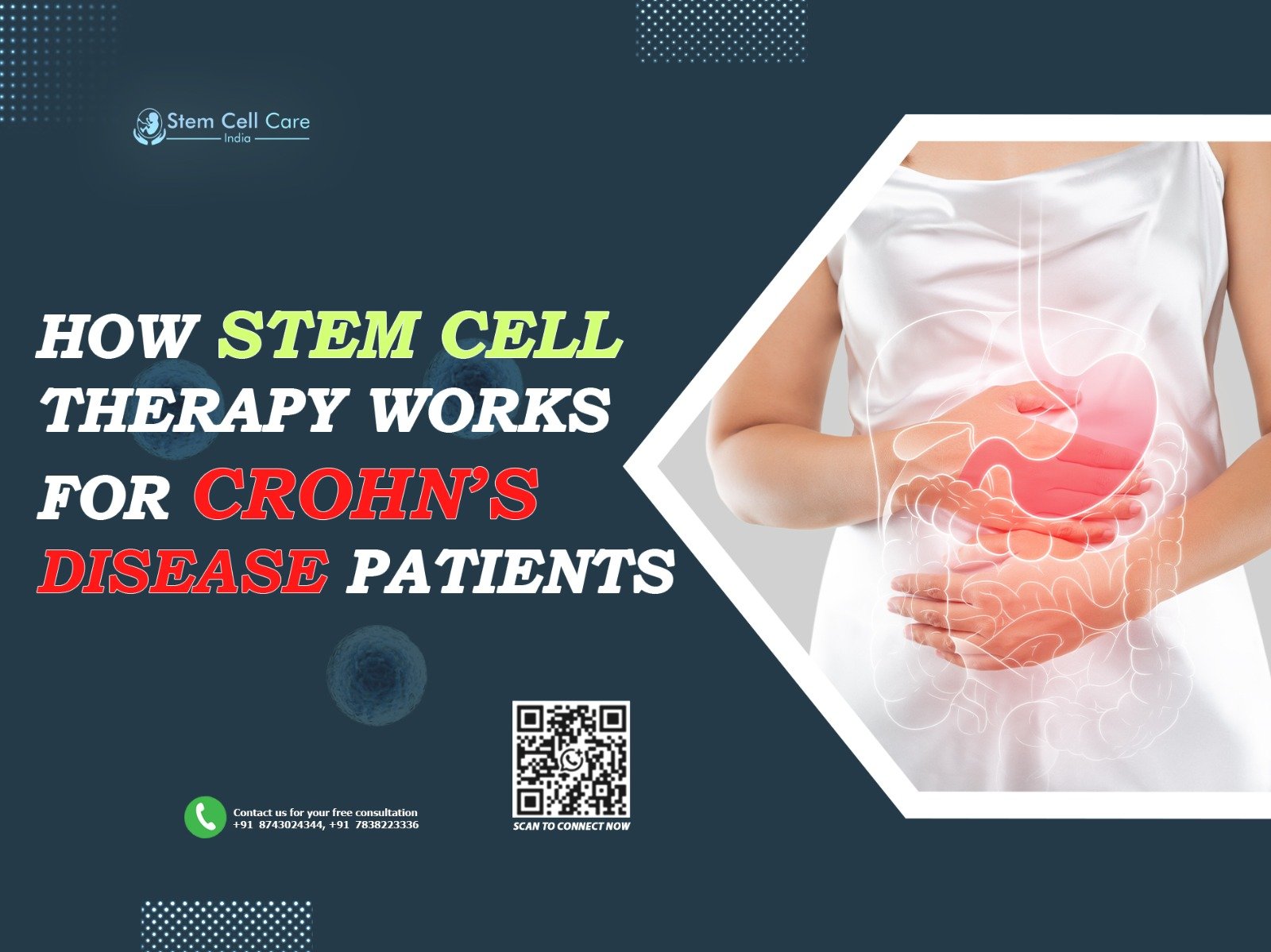
You can understand stem cell therapy as tiny cells that can adapt and develop into different types of cells in the body as per the needs. These cells are being studied for their ability to repair and regenerate. Stem cell therapy for Crohn’s disease is more oriented to discovering the potential of these cells to have an effect on inflammation rather than using them to replace diseased tissues.
This is precisely the area in which research into these therapies is focused—but here there also lie constraints. The treatment itself is currently confined to investigational purposes only.
Where Stem Cell Therapy Fits In
Crohn’s disease is basically the result of an overactive immune response in your body. Stem cells have been characterized as plastic cells which could differentiate into other kinds of cells. The current research in Crohn’s disease is not about the replacement of tissues but rather the effects that the cells would have on the immunity of the body.
Currently, the following areas are being studied to see if stem cells could:
- Regulate immune activities
- Reduce inflammation of the gut
- Foster natural regeneration process
The following types of stem cells are involved in the study:
- Hematopoietic stem cells (HSCs), which are used in some blood disorders
- Mesenchymal stem cells (MSCs), mostly researched on inflammation reactions
- Umbilical Cord-Derived Cells, which are researched on immune system related problems
It should be known that the use of stem cells as a therapeutic agent in Crohn’s disease in India is unapproved and only possible in regulated clinical trials.
Benefits of Stem Cell Therapy for Crohn’s Disease
Looking for benefits of stem cell therapy for Crohn’s disease is—where the real expectations start building. You might have read on papers that stem cells help in reducing inflammation or support healing through repair and regeneration.
The idea is true but still being researched and explored in stem cell research—not confirmed in a consistent and predictable way. Currently, stem cell therapy is:
- Being explored
- Results are not consistent
So it’s better to look at this as a developing area, not a solution that’s already established.
What Research Suggests So Far
Here is where expectations should be managed wisely. You might find some facts about stem cells reducing inflammation or alleviating symptoms. While this notion is under study, it is still not consistently substantiated.
Currently, studies are attempting to clarify:
- If inflammation can be successfully mitigated on an ongoing basis
- The individual’s reaction through time
- The presence of long-term improvements in treating the disease
It is possible that some people will witness improvements, but for others, no change will occur. This factor is the primary reason why this area of medicine is experimental.
How Stem Cell Care India Support Patients
Most patients who reach out to us already have questions—sometimes from what they’ve read, and what they’ve been told. At Stem Cell Care India, the focus is to make things clearer for patients.
We help with:
- Reviewing your case in detail
- Explaining what stem cell research actually means in your situation
- Guiding you through clinical trial-related information
- Assisting with international consultation where legally permitted
- Providing ongoing support and follow-up guidance
We don’t offer unapproved therapies in India. The approach is based on transparency, compliance, and patient safety—aligned with NABH-level standards.
Rehabilitation & Support for Crohn’s Disease
Even exploring newer treatments is one thing but the basics of Crohn’s disease management does not change.
Here’s what still counts on a daily basis:
- Making food choices without aggravating symptoms
- Maintaining low levels of stress
- Attending regular follow-up medical appointments
- Understanding the onset of flare-ups
These things often have a bigger impact than people expect.
Putting It All Together
Dealing with Crohn’s disease is never about a single solution. The treatment requires a more structured approach where various treatment modalities have to be applied. While branches of treatment such as regenerative medicine and stem cell therapy are gaining popularity, the application of these therapies remains in the research stage in India.
It means that a person should learn more and avoid making any assumptions. Being aware of which treatment methods are scientifically proven and tested, which ones are still under investigation and which treatments are legal will allow a patient to make a sound decision in terms of treatment choice.
Stem Cell Care India offers professional advice in case you would like to explore research treatment methods.
Frequently Asked Questions
- Is stem cell therapy approved for Crohn’s disease in India?
No, not as a standard option at present. For patients with Crohn’s disease—it is still considered investigational and remains in clinical trials.
- Why is stem cell research being discussed for Crohn’s disease?
Because of its possible ability to reduce inflammation and immune response. Researchers are studying it, but it hasn’t moved into routine care yet.
- Can it replace current treatment methods?
No. Most patients still rely on medications and regular medical care. Anything under research is usually looked at alongside standard treatment, not instead of it.
- Is it safe to consider stem cell-based approaches?
Yes, but these methods are only discussed in the setting of controlled clinical trials.
Reference Links
National Institute of Diabetes and Digestive and Kidney Diseases (NIDDK) — Crohn’s Disease Overview
https://www.niddk.nih.gov/health-information/digestive-diseases/crohns-disease
PubMed Central — Hematopoietic Stem Cell Transplantation in Refractory Crohn’s Disease
https://www.ncbi.nlm.nih.gov/pmc/articles/PMC6043751/
Frontiers in Immunology — Mesenchymal Stem Cells for Inflammatory Bowel Disease
https://www.frontiersin.org/articles/10.3389/fimmu.2020.575501/full
Nature Reviews Gastroenterology & Hepatology — Stem Cell Therapy in Inflammatory Bowel Disease
https://www.nature.com/articles/nrgastro.2017.37
International Society for Stem Cell Research (ISSCR) — Guidelines for Stem Cell Research and Clinical Translation
https://www.isscr.org/policy/guidelines-for-stem-cell-research-and-clinical-translation