Table of Contents
- Understanding the Basics of Regenerative Therapy
- Role of Stem Cells in Treating Crohn’s Disease
- Recent Clinical Trials for Regenerative Treatment in Crohn’s Disease
- Comparing Regenerative Therapy with Traditional Treatments
- The Future of Regenerative Medicine in Digestive Health
- Consult With Experts: Stem Cell Care India
- The Concluding Thoughts
- Frequently Asked Questions
- Reference Links
Summary: Discover what recent research says about regenerative therapy for Crohn’s disease and why, despite growing interest, it is still considered investigational.
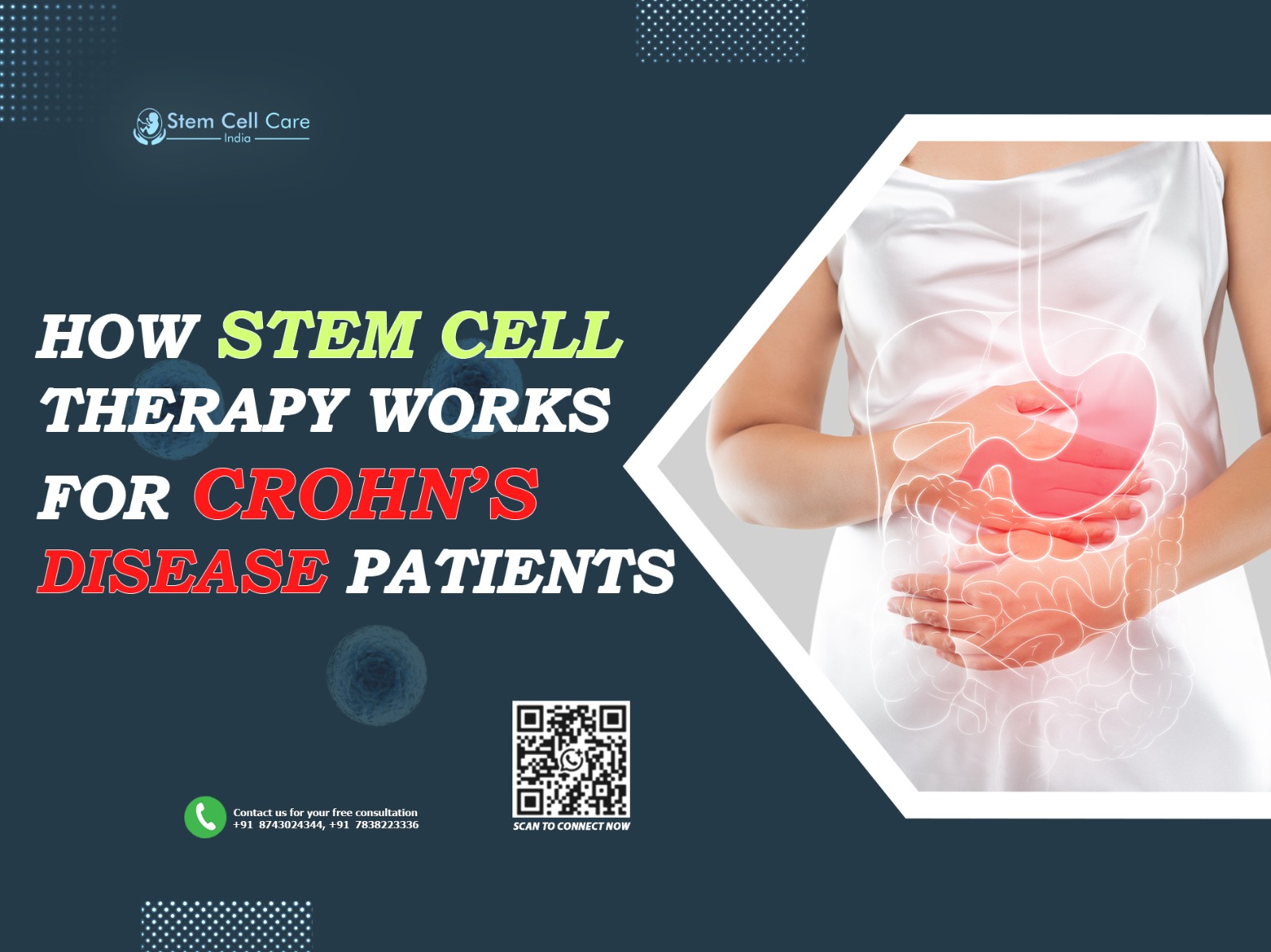
Crohn’s disease is one of those conditions that doesn’t stay predictable for long. It affects the digestive tract, but the impact goes beyond that—energy levels, nutrition, and day-to-day comfort often get affected too. Most patients continue with medications and lifestyle adjustments, but when symptoms keep returning, it’s natural to look for alternatives. That’s where regenerative medicine starts coming into the picture. You might have seen discussions around stem cell research and its potential role in inflammatory conditions like Crohn’s.
The interest is growing, but so is the need to understand what is actually supported by research and what is still being explored. Let’s keep reading to understand better and find the suitable treatment option.
Understanding the Basics of Regenerative Therapy
Regenerative therapy is a broad term used for approaches that aim to support the body’s natural repair processes. Instead of only managing symptoms, the idea is to understand whether healing at a cellular level can be influenced.
In Crohn’s disease, the focus is mainly on how inflammation can be controlled and whether damaged intestinal tissue can recover more effectively. Stem cell research is a key part of this field, especially because of its potential role in immune regulation. That said, this area is still developing. Most findings and information comes from ongoing studies rather than established clinical practice.
Role of Stem Cells in Treating Crohn’s Disease
The issue with stem cells for Crohn’s disease lies in their potential functions. The illness is caused by the overreaction of the immune system, which results in inflammation in the intestinal tract in the body.
In this case, the research team does not look at stem cells as a cure for Crohn’s disease—instead, examines whether they can influence how the immune system behaves.
Present studies on stem cells are trying to determine if stem cells have the ability to:
- Alter the performance of the immune system
- Decrease inflammation
- Promote healing of the affected area of the intestine
As this treatment is still part of ongoing research—results may vary depending on the patient.
Recent Clinical Trials for Regenerative Treatment in Crohn’s Disease
Over the years, there have been so many research and clinical trials on regenerative medicine for Crohn’s disease. With focus on evaluating safety, feasibility, and how patients respond to it.
Research that is underway involves:
- The interaction between stem cells and inflammatory pathways
- Their effect on tissue regeneration in the gut lining
- Patient follow-up in the long term
These outcomes have been conflicting to date. In some cases, there are indications of success, whereas in other cases, more data control is required. That is precisely why they are still considered investigational, and thus can be performed only in controlled clinical trials.
Comparing Regenerative Therapy with Traditional Treatments
Patients undergoing traditional treatment often find only symptom based relief—which involves:
- Anti-inflammatory medications
- Immunosuppressants
- Biologic therapies
- In some cases, surgical intervention could be the option
These methods are well-studied and remain the standard approach. On the other hand, regenerative medicine sits as a potential alternative and is still being explored. Stem cell therapy isn’t a new therapy that will replace existing treatments but an idea worth exploring in the future, but certainly not a replacement of what we have today.
The Future of Regenerative Medicine in Digestive Health
There is a great interest in regenerative medicine as it stands today—how it could shape the future care for Crohn’s disease. As researchers are working towards:
- Better understanding of immune response mechanisms
- Identifying which patients may benefit more
- Developing consistent treatment protocols
However, progress in this field takes time. More large-scale and long-term studies are needed before these approaches can be considered part of standard care. For now, regenerative therapy remains an emerging area under research.
Consult With Experts: Stem Cell Care India
At Stem Cell Care India, many patients come to us with unanswered questions and concerns related to their condition—feeling confused and unsure of the treatment.
That’s where our regenerative medicine experts step in. We help patients look at their situation more clearly by:
- Reviewing medical history and current condition in detail
- Explaining what stem cell research means in a practical, case-specific way
- Guiding on whether any clinical trial pathways may be relevant
- Assisting with international consultation options, where legally permitted
- Providing continued support around rehabilitation and overall care
We don’t provide unrealistic expectations but educate with the right info. The focus is on helping you understand your options properly, so decisions are based on clarity—not assumptions—while staying aligned with NABH-level standards and current regulations.
The Concluding Thoughts
Suffering from inflammatory conditions like Crohn’s disease is a painful experience. Currently, the best way to manage the condition is to follow a steady and guided approach. While regenerative medicine opens new doors of possibilities—it remains a part of the evolving field.
Understanding the difference between research and regular treatment is the rightful way to assess the right treatment without falling for unreal expectations. With the right guidance, patients can explore emerging options carefully while staying grounded in safe and proven management strategies.
Frequently Asked Questions
Q1. Is stem cell therapy an approved treatment for Crohn’s disease?
Not yet as standard care. It’s still in research, though certain cases — like fistulas — have shown real promise worth knowing about.
Q2. What type of stem cell therapy is being studied for Crohn’s?
Mainly two — one that resets the immune system, another that reduces inflammation and helps tissue heal. Both are still being studied closely.
Q3. Who might be a candidate for stem cell therapy?
Usually people whose Crohn’s hasn’t responded to standard treatments. If you’ve tried multiple options without real relief, it’s worth a proper conversation.
Q4. Are there risks involved with stem cell therapy for Crohn’s?
Yes, especially with immune-suppressing approaches. Any honest specialist will explain the full picture before you consider anything further.
Q5. What’s a realistic expectation going into stem cell therapy?
Some people see significant improvement. Others see modest results. Go in seeking clarity about your specific case—not a guaranteed outcome.
Reference Links
National Institute of Diabetes and Digestive and Kidney Diseases (NIDDK) — Crohn’s Disease Overview
https://www.niddk.nih.gov/health-information/digestive-diseases/crohns-disease
PubMed Central — Hematopoietic Stem Cell Transplantation in Crohn’s Disease
https://www.ncbi.nlm.nih.gov/pmc/articles/PMC6043751/
Frontiers in Immunology — Mesenchymal Stem Cells in Inflammatory Bowel Disease
https://www.frontiersin.org/articles/10.3389/fimmu.2020.575501/full
Nature Reviews Gastroenterology & Hepatology — Stem Cell Therapy in IBD
https://www.nature.com/articles/nrgastro.2017.37
International Society for Stem Cell Research (ISSCR) — Clinical Translation Guidelines
https://www.isscr.org/policy/guidelines-for-stem-cell-research-and-clinical-translation