Table of Contents
Summary: Discover how regenerative medicine works and how it can help you manage retinitis pigmentosa, a progressive condition that affects your vision. Read the blog to find out more about the potential and benefits of regenerative medicine.
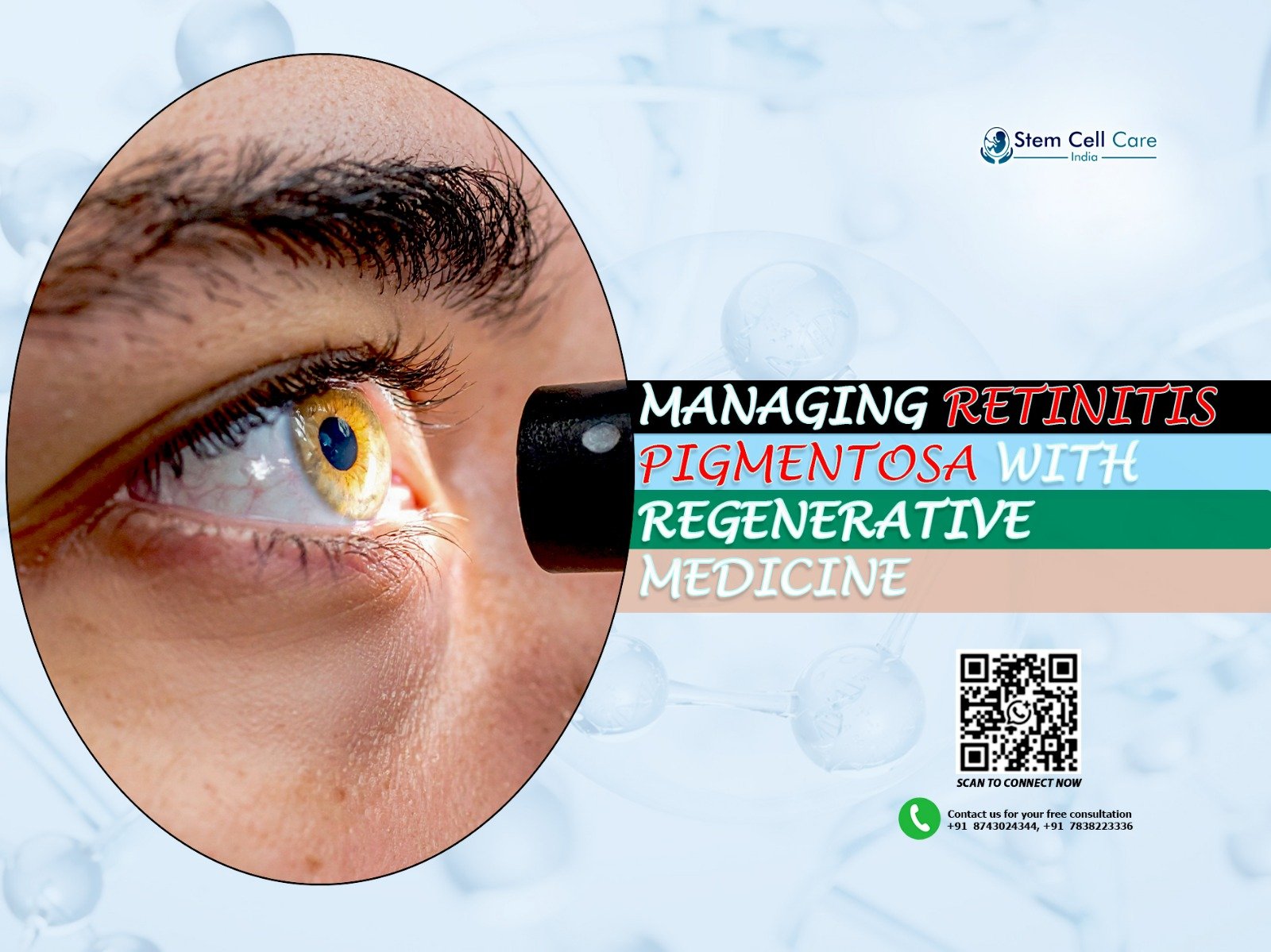
Millions of patients around the world suffer vision loss due to the condition known as retinitis pigmentosa, a group of conditions that gradually affects the photoreceptor in the patient’s eye leading to complete blindness. Although some traditional treatments offer temporary solutions, they remain limited. On the other hand, with good advancement in regenerative medicine, patients now hope for more advanced supportive treatment, especially stem cell treatment. This treatment uses the stem cells to repair the retinal cells in the eye to restore the lost vision and overall functions.
It is always advisable to find out what the scientific evidence actually says before deciding on any treatment.
What Is Retinitis Pigmentosa?
Retinitis pigmentosa refers to a group of hereditary disorders that cause the deterioration of specialized photoreceptor cells called rods and cones, which are located in the retina.
Key Characteristics:
- Gradual loss of night vision
- Tunnel vision because of peripheral retinal damage
- Sensitivity to light
- Progressive central vision loss
- Genetic mutations by which retinal cells survive
Understanding the RP initially affects rod cells, then cone cells. Consequently, it gradually reduces the patient’s vision.
Role of Regenerative Medicine in Managing Retinitis Pigmentosa
Regenerative medicine doesn’t focus on reversing a disease but rather on how cells can be repaired. Hence, it is a more advanced therapy option than simply symptom relief. In the case of retinitis pigmentosa (RP), the damage to the retina is due to a loss of photoreceptors that continues over time, thus causing a gradual loss of eyesight. However, stem cell treatment and other cell therapies are now being explored for their potential to protect and restore the retina.
Key Ways Regenerative Medicine Helps Manage Retinitis Pigmentosa
Here are the following:
Neuroprotective Support
- Mesenchymal stem cells release neurotrophic factors, including brain-derived neurotrophic factor and ciliary neurotrophic factor.
- These factors may be helpful in protecting the existing retina from further deterioration.
Anti-Inflammatory Ability
- The process of chronic retinal degeneration essentially involves inflammatory pathways.
- MSCs have the potential to modulate the immune response, thereby reducing the inflammatory reactions in the microenvironment.
Oxidative Stress Reduction
- In retinitis pigmentosa, oxidative stress causes damage in the photoreceptor cells.
- Stem cells can secrete antioxidant-inductive substances, hence stabilizing retinal cells in the process.
Paracrine Signaling Mechanisms
- Rather than directly restoring damaged cells like most approaches currently attempt to do, stem cells stimulate healing by means of paracrine effects.
- They release bioactive molecules that affect cells nearby and drive survival mechanisms.
Retinal Pigment Epithelium (RPE) Cell Replacement
- New experimental ways of regeneration involve the transplantation of retinal pigment epithelial cells obtained from stem cells.
- The idea is to preserve layers of the retina essential for the healthy functioning of photoreceptors.
Disease Progression Management, Not Genetic Correction
- Regenerative medicine is indeed an innovative and potentially effective treatment.
- It is important to note that current regenerative medicine approaches do not correct the underlying genetic mutations responsible for retinitis pigmentosa. The primary goal is preservation and functional support rather than complete reversal.
Clinical Studies and Emerging Evidence
As you may have known, stem cell treatment is being studied for different conditions. Here are essences:
- The main focus of phase I/II trials is safety and tolerability.
- Some studies show that temporary improvements in function occur in visual acuity.
- Long-term effectiveness and durability are under investigation.
Current data appears to imply its potential benefit, but not a cure.
What It Means for the Patients
Patients with retinitis pigmentosa can consider regenerative medicine as a supportive treatment and not a definite solution yet. Several clinical trials have exhibited the safety of the early phases and also the possibility of some supportive benefits, however, the results of the studies are inconsistent. It is very important that a thorough check up is done so as to know if you are fit for the treatment and to have rational expectations.
Fortunately, as a regenerative medicine consultancy, Stem Cell Care India helps patients by reviewing medical history, evaluating clinical evidence, and connecting individuals with ethically guided treatment centers.
The Bottom Line
Managing retinitis pigmentosa is still a complex task due to the genetic process of the disease. Regenerative medicine, along with stem cell therapy, is believed to manifest its potential for the patient’s retinal support, although it is still evolving. Stem Cell Care India provides informed consultation based on the evidence for decision-making in accordance with research.
Frequently Asked Questions
Q1. Is stem cell therapy a cure for retinitis pigmentosa?
Ans. No. Research indicates the possibility for support, but there is no concrete cure through stem cell therapy yet.
Q2. Are clinical trials for RP ongoing?
Ans. Yes. There are multiple early-phase studies underway to assess safety as well as possible improvements in visual function.
Q3. Can stem cells restore lost vision completely?
Ans. Evidence for vision restoration does not support full restoration. Research has focused on preservation and support.
Q4. Is stem cell therapy safe for retinal conditions?
Ans. The safety profiles are acceptable in early-phase trials, although the long-term data are limited.
Q5. How can Stem Cell Care India help RP patients?
Ans. They offer evidence-based consulting and help patients navigate ethical and well-regulated options for regenerative treatment.
Reference Links
National Eye Institute – Retinitis Pigmentosa
https://www.nei.nih.gov/learn-about-eye-health/eye-conditions-and-diseases/retinitis-pigmentosa
PubMed Central – Stem cell therapy for retinal degenerative diseases
https://www.ncbi.nlm.nih.gov/pmc/articles/PMC6950588/
Clinical Ophthalmology – Stem cell clinical trials in retinal diseases
https://www.ncbi.nlm.nih.gov/pmc/articles/PMC5844223/
Nature Reviews Neurology – Cell therapy strategies for retinal degeneration
https://www.nature.com/articles/nrneurol.2017.30
ISSCR Guidelines for Stem Cell Research and Clinical Translation
https://www.isscr.org/policy/guidelines-for-stem-cell-research-and-clinical-translation